On Being an 'Auxiliary' Adult
Author's Note: This is my account, from my life and my experience. It is not a statement on behalf of anyone else who is childfree. The children I mention are in my life with the implicit trust of the adults who care for them. Their privacy is protected.

I heard them before I saw them
That morning, I meditated. Then I put on my favourite dance songs and moved around the house until something in me loosened. This is preparation. When I enter a workshop space, one of my biggest responsibilities is to show up as authentically as possible. Every single time. They read the room before they read anything else. If I walk in carrying something unprocessed, something unacknowledged, the process cannot happen.
So I meditate. I dance. I arrive.
I heard them before I saw them. "Nidhi tai aalya! (Nidhi tai is here!)" Loud, overlapping voices from somewhere inside the building as I stepped out of the auto rickshaw. Their caretaker met me at the door. She told me the girls had finished most of their work and their meal before noon, asking when I'd arrive since morning. She said it in the tone of someone who had answered the question several times already. I smiled.
I remember thinking that I must've done something right in the previous workshops. And then, almost immediately after that thought, the weight of the responsibility settled back in. Which is also right. Which is also how it should feel.
I am an 'auxiliary' adult. I did not have a name for it until recently. But that is what I am — not a parent, not a guardian, not someone who holds a child's life in the full and permanent way that parents do. Someone who shows up, by choice, because she wants to be there. An aunt. A facilitator.
The most extreme version of yourself

My nieces sit on my back with their kitchen set having a tea party. I have long conversations with them about everything and nothing. I sing songs for my baby nephew even though I cannot sing, because he is raises his eyebrows and smiles. I make silly faces, become part of their games, and sit cross-legged on the floor. I don't worry about how I am being perceived in these moments by other people in the room. I like that version of me.
I read somewhere a while ago, that you should be the most extreme version of yourself so that people around you would not want to be anything but themselves. I am paraphrasing. But I think about it often. I try.
When the girls at the hostel saw me being silly and playful during our first workshop together, it gave them permission to be themselves. That is not a teaching strategy. It is just what happens when someone stops performing.
Kids are some of the funniest individuals I know. They have an emotional attunement that I find genuinely... remarkable. They know when something is off in a room before anyone names it. They pick up on the gap between what an adult is saying and what they are feeling, with an accuracy that is, honestly, startling.
Their instincts are sharp and largely uncorrupted. Their curiosity is not performed. Their willingness to try is authentic. They do not stand at the edge of something new, weighing whether the attempt is worth the risk of looking foolish. They just try. I find myself in awe of this, repeatedly. Not in a sentimental way but in a genuine, 'where did the rest of us lose this' way.

The stories children tell are important. Even the made-up ones. Especially the made-up ones. A child who tells you a story set in a fantasy world, with impossible rules and characters who can do things that physics does not allow, is telling you something real. Something about what they are trying to process, or what they wish were different. If we do not listen to these stories because we are busy, or because we have decided they are just playing, we are doing a disservice. To our own sense of wonder. To the part of us that still knows how to imagine things that do not exist yet. These stories are important because that is where hope lives.
As an auxiliary adult, I get to be in the room for these stories. I get to listen without the weight of every other decision a parent carries simultaneously. That is not a lesser position. It is a different one. And it comes with its own particular kind of responsibility.
In conversation with myself
Sometimes we know what a child needs, because we all were there at some point.
Every adult was a child once. But I think many of us forget to stay in conversation with that version of ourselves. We grow past her and then spend years being politely estranged from her. Not hostile. Just distant. She becomes someone we used to be rather than someone we are still in relationship with.
I try not to do that.

What heals the child in me is the dance songs before a workshop. Playing with colours and patterns in my sketchbook. Hanging out with my loved ones. Writing in my journal. Reading children's literature. Watching feel-good animated films. Being silly, laughing at my own jokes, even making weird faces at the CCTV cameras around me. Holding my own hand when that is what is needed. Opening my home to the people I love when they need somewhere to be. These are not small things. These are the things that keep me in conversation with myself. It's an old saying - physician, heal thyself. The work I do with children is not separate from this. It is the same work, looked at from a different angle.
I should also say: I am not a fully formed individual. I am learning about myself every day. Sometimes I am creating myself as I go, moment to moment. But that is how I am. And I do not mind it too much. I like to surprise myself. It is funny when I think: oh, I know this? I am interested in this? I can do this?
I believe children feel this way about themselves too, when they are allowed to. When the room and the people in it makes space for it. Part of what an auxiliary adult can offer is exactly this: the reminder, as example, that not being fully formed is not a problem. It is just being alive.
What are we asking of them and Why?
Children today are under pressure to grow up faster than growing up actually works. To perform a maturity that has not had time to develop. To arrive at a fixed idea of who they are before they have had the chance to simply be, in all the unfinished, contradictory ways that being young is supposed to feel. The world is genuinely loud, genuinely unsafe, and genuinely too much. Families are doing their best inside systems that are asking more of everyone than any of them signed up for. That is true and it matters.
But there is also this. Social media platforms present children and teenagers with modern archetypes to choose from before they have had the time to figure out who they are as individuals. The pressure to choose one, and to make it visible and consistent and appealing to others, arrives very early. Earlier than most of us register.
There is also the sheer volume of information, opinion, conflict, and noise that children are expected to metabolise before they have the tools to do so. We ask a lot. We ask it quietly and constantly, and we do not always notice we are asking.
But underneath all of this is something older. An idea about children that we have inherited and not fully examined. The previous generation operated under the idea that children must be seen, not heard. What I see now is different. But I am not sure it is better. These days, with some people the idea seems to be: we don't mind if children are seen or heard. But they should be perfect.
Every day we ask children to dim their light for the convenience of adults. We ask them to be mature before maturity has had time to arrive. To know who they are before they have had the time to find out.
This is where auxiliary adults have something specific to offer. We are not inside the pressure system in the same way. We cannot remove the pressure; it is structural, real, and larger than any of us. But we can create one room, one afternoon, one relationship, that operates differently. Where the instruction is not to perform but to 'come as you are.'
That is what I am trying to do. That is what I keep showing up for.
Who is an auxiliary adult?
New parents are trying their best. I see this clearly. Parenting in 2026, in this country and this world, is genuinely difficult in ways that are not always acknowledged. But parenthood is not the only relationship adults have with children.
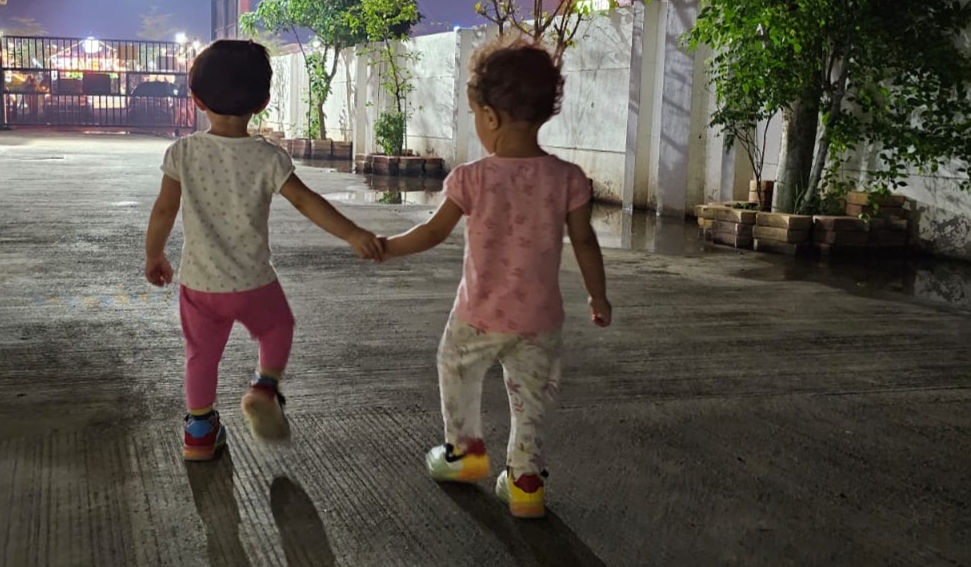
There are also those of us who are what I would call auxiliary adults. The aunts and uncles. The teachers and facilitators. The family friends, the neighbours, the people who are in a child's life not by obligation but by circumstance and by choice. We matter too. The question of whether we are doing our best for the children in our lives belongs to all of us. Not only to parents.
I am childfree. I hold that decision close. What I have come to understand is that children, honestly, do not care. If you are showing up for them authentically, if you are creating a space where they feel safe to explore, they do not care about your personal life. They are not interested in your reproductive choices. They are interested in whether the room feels safe. Whether the person at the front of it is genuinely present.
What I would gently push back on is the assumption that my relationship with children is somehow lesser because of the choice I have made. My personality is not based on just this one thing. And my love for the children in my life is not conditional on anything.
I am trying to be a good auxiliary adult. That is the honest answer. I do not always get it right. But I am trying.
Our collective responsibility
Many of my colleagues in the applied theatre space are doing genuinely important work. Creating rooms where children can exist as they are, be who they are, and choose to walk away with what they want. These colleagues are not my competitors. Anyone who is trying, with sincerity, to create safe spaces for children and young people will always have my respect and support. The need is large enough and urgent enough that there is room for all of us.

But it is not only applied theatre practitioners. It is teachers who stay after class for the student who is struggling- maybe with academics, maybe something more. Social workers navigating impossible systems on behalf of children who have no one else. Extracurricular mentors and coaches who offer the child a space that school cannot. People working in policy, in design, in healthcare, in community organising, whose work shapes the conditions children grow up inside, even when children are not in the room.
Anyone working directly with children, or indirectly for them, is doing a version of this same work. We are a larger community than we sometimes recognize.
And because we are a large community, and because we are working with one of the most vulnerable sections of society, I want to say something directly. Vigilance matters. Background checks matter. Not to gatekeep who gets to care about children. But because the safety of the child in the room is the first responsibility, before anything else. Before the programme, before the methodology, before the intention. If we are serious about creating safe spaces, we have to be serious about who is in them. That is not a bureaucratic concern. It is an ethical one.
What we are have is the recognition that it is our responsibility to create spaces- physical, emotional, and educational, where children are genuinely safe.
Not performatively safe. Not safe in ways that are convenient for the adults around them. Actually safe. Safe enough to not know yet. Safe enough to try and fail. Safe enough to feel something without being told to put it away.
We are not always succeeding at this. But we are all trying, and that's what counts. I think it is important to say that plainly.
Where I'm supposed to be
I am childfree. And the children in my life are, without any ambiguity, in my life. Fully. My nieces and nephews, the girls at the hostel, and the ones who walk into workshops. Not as a substitute for something I am missing. But as people I genuinely love spending time with, learning from, and showing up for.

There is something particular about choosing to be in rooms with children, over and over, without obligation. Just because we want to. Because something in us settles when we are there. Because we can be most ourselves, playful and authentic. That version of us is enough. More than enough. I think that is what it feels like to be exactly where you are supposed to be.
That is what I want to leave you with. Not an argument. Just a question to sit with.
Who are the children in your life? Not the ones you are responsible for on paper. The ones you have chosen to show up for.
Are you showing up for them the way they deserve? Not perfectly. Just authentically. Just present.
What kind of auxiliary adult do you want to be?


So Beautifully expressed Nidhi! Making spaces feel safe for the kids in our lives is as important as being a part of a larger community which fosters their growth. I really appreciated that you explained it so succinctly. Please keep writing these articles/experiences they shed a light on many topics which haven't been talked about!